

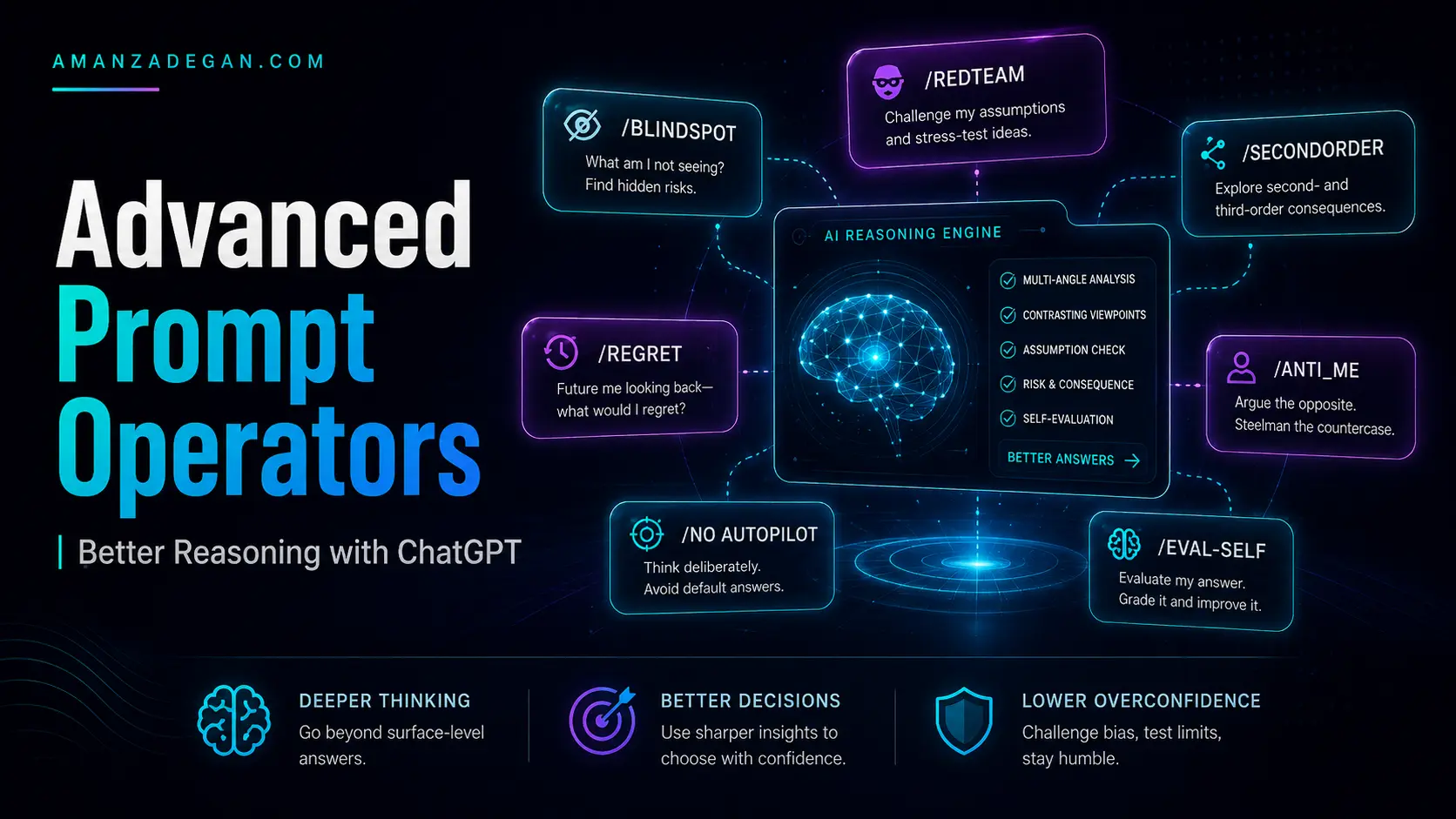

Advanced ChatGPT prompt operators are not just shortcuts for formatting. They are quality-control tools. They help you challenge assumptions, reduce overconfidence, find hidden risks, and turn ChatGPT from a polite answer generator into a more useful critical assistant.
This article focuses on the professional command set: /REDTEAM, /BLINDSPOT, /SECONDORDER, /REGRET, /ANTI_ME, /NO AUTOPILOT, /PITFALLS, /GUARDRAIL, and /EVAL-SELF. These are user-defined prompt operators, not guaranteed official product commands, but they can dramatically improve response quality when used clearly.
Table of Contents
Quick Summary
| Operator | Purpose | Best For | Main Risk If Misused |
|---|---|---|---|
| /REDTEAM | Challenge an idea aggressively | Strategy, architecture, business plans | Can become too negative if not paired with a recommendation |
| /BLINDSPOT | Find missing assumptions | Complex decisions | May produce speculative risks without enough context |
| /SECONDORDER | Analyze downstream effects | Long-term planning | Can overcomplicate simple tasks |
| /REGRET | Identify future regret points | Important decisions | Can focus too much on loss avoidance |
| /ANTI_ME | Challenge the assistant’s first recommendation | Reducing overconfidence | Can create indecision if no final recommendation is requested |
| /EVAL-SELF | Critique answer quality | Final drafts, source-based answers | Needs a clear quality standard |
Why Advanced Prompt Operators Matter
Most weak AI outputs fail for the same reasons: not enough context, shallow assumptions, generic advice, unsupported certainty, and no serious review. Advanced prompt operators address those failure modes directly.
For example, a normal prompt may ask:
Is this plan good?A stronger prompt asks:
/NO AUTOPILOT /REDTEAM /PITFALLS /ANTI_ME
Review this plan as a skeptical senior reviewer. Identify weak assumptions, failure modes, and what you would change before execution. End with a recommended path.
The second version is better because it defines the behavior you want. It asks for criticism, risk detection, self-correction, and a final recommendation.
The Critical Thinking Command Set
The following operators work best when you define what they should evaluate. Do not use them as decoration. A command like /REDTEAM should specify the reviewer perspective: investor, senior engineer, professor, HR manager, compliance officer, skeptical customer, or future maintainer.
| Command | What It Should Force ChatGPT to Do | Good Pairings |
|---|---|---|
| /NO AUTOPILOT | Avoid generic, agreeable, templated answers | /PITFALLS, /EVAL-SELF |
| /DELIBERATE THINKING | Slow down and reason carefully | /GUARDRAIL, /SYSTEMATIC BIAS CHECK |
| /SYSTEMATIC BIAS CHECK | Find hidden assumptions and weak evidence | /BLINDSPOT, /ANTI_ME |
| /PITFALLS | List likely traps, edge cases, and failure modes | /CHECKLIST, /METRICS MODE |
| /GUARDRAIL | Set hard boundaries and what not to do | High-stakes topics |
| /EVAL-SELF | Critique the answer before finalizing | Final deliverables |
| /PARALLEL LENSES | Review from multiple professional perspectives | Business and technical decisions |
How to Use /REDTEAM
/REDTEAM asks ChatGPT to attack an idea before you invest time, money, or reputation into it. It is useful for business plans, technical architecture, research claims, content strategy, negotiation messages, and product decisions.
Weak Usage
/REDTEAM
Is my idea good?
Strong Usage
/REDTEAM
Act as a skeptical technical lead, SEO strategist, and future maintainer. Attack this plan. Find hidden risks, weak assumptions, maintenance problems, and credibility issues. Then give a corrected version.
When to Use It
- Before launching a service
- Before sending an important email
- Before choosing a software architecture
- Before publishing a strong claim
- Before committing to a long content strategy
- Before making a migration, banking, or business decision
How to Keep It Productive
A red-team review should not end with negativity. Always ask for a corrected plan, ranked risks, or a recommended next step. Otherwise the output can become critical but not actionable.
How to Use /BLINDSPOT
/BLINDSPOT is for finding what you may not be seeing. It is softer than /REDTEAM but often more useful during planning. It can reveal missing stakeholders, missing data, weak context, hidden costs, technical debt, or future constraints.
/BLINDSPOT
Review this decision. What am I not considering? Separate technical, financial, operational, reputation, and long-term risks.
Use it when you feel the plan is good but incomplete. It is especially effective for multi-context work where personal assumptions can leak into a client project or business decision.
How to Use /SECONDORDER
/SECONDORDER looks beyond the immediate result. It asks: what happens after the first success? What changes six months later? What maintenance burden does this decision create?
/SECONDORDER
If we choose this WordPress structure, what consequences might appear after 3, 6, and 12 months? Consider SEO, content scaling, internal links, maintenance, and technical debt.| First-Order Thinking | Second-Order Thinking |
|---|---|
| This plugin solves the issue today. | Will this plugin slow the site, conflict with caching, or create lock-in later? |
| This article can rank for a broad keyword. | Will it cannibalize future articles or create unclear search intent? |
| This code works in the current test. | Will it survive platform constraints, edge cases, and team maintenance? |
| This message is direct. | Will it damage the relationship or weaken negotiation position? |
How to Use /REGRET
/REGRET is a decision-quality operator. It asks ChatGPT to identify what you may regret later if you act now. It is useful when a choice feels urgent but has long-term consequences.
/REGRET
If I publish this article as-is, what might I regret later from an SEO, credibility, brand, or maintenance perspective?
This command is particularly useful for public writing, legal-sensitive claims, bank communication, career negotiation, and technical architecture. It turns vague risk into concrete future pain points.
How to Use /ANTI_ME
/ANTI_ME is one of the most useful commands for reducing overconfidence. It asks ChatGPT to argue against its own first recommendation. This is valuable because AI answers can sound polished even when they are incomplete.
/ANTI_ME
First give your recommendation. Then argue against it as strongly as possible. Finally, revise your recommendation based on the strongest objections.
The final revision is the important part. Without it, /ANTI_ME can leave you with two opposing views and no decision.
Quality-Control Stacks
For Technical Architecture
/DEV MODE /REDTEAM /PITFALLS /SECONDORDER /EVAL-SELF
Review this architecture for production use. Focus on correctness, maintainability, performance, team workflow, edge cases, and future refactor risk.
For Academic or Research Writing
/DELIBERATE THINKING /SYSTEMATIC BIAS CHECK /GUARDRAIL /EVAL-SELF
Review this paragraph for unsupported claims, weak evidence, overclaiming, vague wording, and examiner objections.
For SEO and Website Content
/AUDIENCE: target searcher
/METRICS MODE /PITFALLS /GUARDRAIL /REGRET
Review this page for search intent, trust, conversion, internal linking, thin content, and risky claims.
For Important Communication
/TONE professional and firm
/REGRET /EVAL-SELF /GUARDRAIL
Rewrite this message so it is clear, respectful, credible, and not weak, aggressive, emotional, or over-explained.
Examples by Scenario
| Scenario | Recommended Stack | Why It Works |
|---|---|---|
| Code review | /DEV MODE /PITFALLS /EVAL-SELF | Finds bugs and production risks instead of only explaining the code |
| SEO article review | /AUDIENCE /METRICS MODE /GUARDRAIL | Aligns content with search intent, measurement, and trust |
| Business decision | /REDTEAM /SECONDORDER /REGRET | Challenges the decision and checks future consequences |
| Academic writing | /SYSTEMATIC BIAS CHECK /EVAL-SELF | Reduces unsupported claims and weak logic |
| Client message | /TONE /REGRET /GUARDRAIL | Protects professionalism and relationship |
FAQ
Are these advanced operators official ChatGPT commands?
They are best treated as user-defined prompt operators. They work because they communicate a clear instruction.
Can these commands make ChatGPT perfectly accurate?
No. They improve quality control, but they do not replace evidence, source checking, or domain expertise.
Which command should I use most often?
For professional work, /PITFALLS and /GUARDRAIL are often the most practical. For decisions, add /REDTEAM, /SECONDORDER, and /REGRET.
Can too many critical commands make the answer worse?
Yes. Too much criticism without a requested final recommendation can create indecision. Ask for ranked risks and a corrected path.
Final Takeaway
Advanced prompt operators are most valuable when the work matters. Use them to slow down, challenge assumptions, find hidden risks, and improve final quality. The goal is not to make ChatGPT sound more complex; the goal is to make the output more useful, reliable, and professionally defensible.
How to Prevent Critical Commands from Becoming Too Negative
Critical commands are useful, but they can also overcorrect. A red-team review that only lists risks may leave the user more confused. A regret analysis that only focuses on worst-case outcomes may become too conservative. To keep critical prompts useful, always ask for a corrected path, ranked severity, or final recommendation.
/REDTEAM /PITFALLS
Critique this plan, but do not stop at criticism. Rank the issues by severity and give a corrected version that preserves the original goal.
The Professional Review Pattern
For important work, use a repeatable review pattern. This makes the answer more structured and less likely to become a loose list of opinions.
| Step | Question | Output |
|---|---|---|
| 1. Objective | What are we actually trying to achieve? | Clarified goal |
| 2. Evidence | What do we know and what is assumed? | Confirmed facts vs assumptions |
| 3. Risks | What could fail? | Pitfalls and edge cases |
| 4. Alternatives | What else could work? | Option comparison |
| 5. Consequences | What happens later? | Second-order effects |
| 6. Recommendation | What should we do now? | Clear next step |
High-Stakes Prompt Example
For decisions involving money, reputation, code architecture, migration, academic claims, or client commitments, a stronger prompt can combine multiple quality controls without becoming chaotic.
/NO AUTOPILOT /DELIBERATE THINKING /SYSTEMATIC BIAS CHECK /REDTEAM /SECONDORDER /REGRET /ANTI_ME

Context:
[Explain the situation]

Task:
Analyze the decision carefully. Separate confirmed facts from assumptions. Find hidden risks, challenge the default option, compare alternatives, and identify what I may regret later.

Output:
1. Clarified objective
2. Key assumptions
3. Risk table
4. Option comparison
5. Anti-recommendation
6. Final recommendation
7. What to verify before acting
A Common Trap: Confusing Confidence with Quality
A polished AI answer can still be wrong. Advanced prompt operators help reduce that risk, but they do not remove the need for verification. For current facts, policies, laws, prices, product features, and source-based academic work, the model should verify information against reliable sources. Critical prompting improves reasoning; it does not magically create evidence.
Recommended Next Reading
Continue with the related guides in this content cluster:
- ChatGPT Slash Commands: The Complete Guide to Operators, Shortcuts, and Prompt Modes
- Official ChatGPT Shortcuts: Canvas, Search, Memory, and App Commands Explained
- ChatGPT Commands for Developers, SEO Specialists, and Business Workflows
- How to Build a Personal ChatGPT Command Library