

AI Scan-to-BIM: Computer Vision, Point Clouds and the Future of Existing Building Documentation

AI Scan-to-BIM: Computer Vision, Point Clouds and the Future of Existing Building Documentation
Existing buildings are often the most difficult part of digital architecture. New projects may begin with clean BIM models, organized drawings, and structured design intent. Existing buildings rarely offer that level of clarity. They may have outdated drawings, undocumented changes, missing maintenance records, hidden systems, and years of modifications that were never properly modeled.
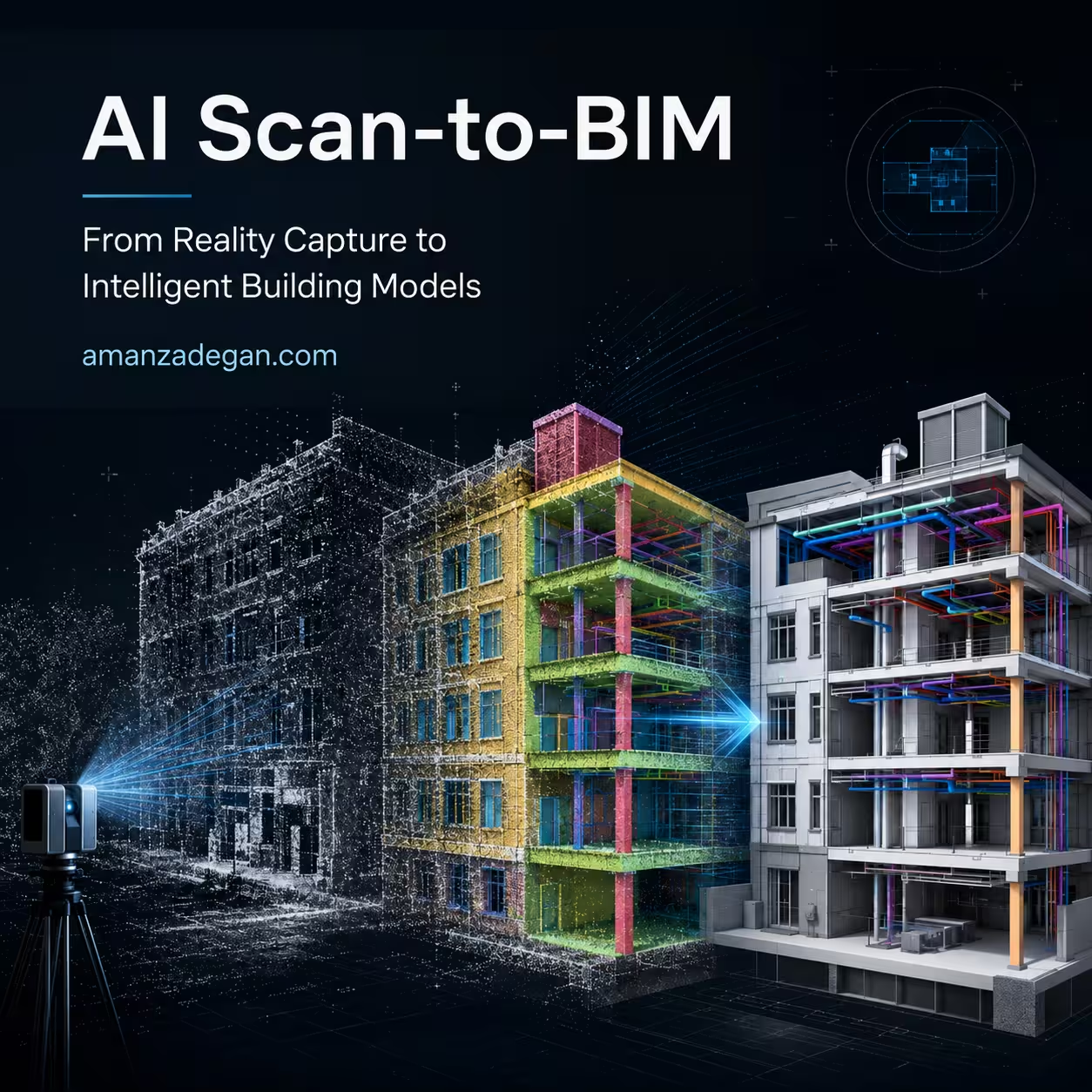
This is why Scan-to-BIM has become increasingly important. Scan-to-BIM uses reality capture technologies such as laser scanning, LiDAR, photogrammetry, and point clouds to create accurate digital models of existing assets.
When combined with AI and computer vision, the workflow becomes more powerful: the system can begin to detect elements, classify objects, identify walls and slabs, support geometry reconstruction, and prepare data for BIM or digital twin use.
Why Existing Building Data Matters
A large part of architectural work involves existing buildings: renovation, adaptive reuse, heritage documentation, facility management, interior redesign, energy retrofit, safety assessment, MEP upgrades, asset digitization, and urban regeneration.
In these projects, the biggest risk is often uncertainty. If the existing condition is not documented accurately, design decisions become fragile.
What Is Scan-to-BIM?
Scan-to-BIM is the process of capturing an existing building and converting that captured data into a BIM model. A typical workflow includes site scanning, point cloud creation, point cloud cleaning and registration, element identification, BIM modeling, validation against scan data, and delivery of BIM, IFC, CAD, or digital twin-ready outputs.
Traditional Scan-to-BIM can be labor-intensive. Human modelers often need to interpret point clouds manually and reconstruct building elements element by element. AI can help automate parts of this process.
How AI Improves Scan-to-BIM
Semantic segmentation
Computer vision models can classify parts of a point cloud as walls, floors, columns, ceilings, doors, windows, pipes, ducts, or structural elements.
Object recognition
AI can detect repeated components such as windows, fixtures, furniture, or MEP equipment.
Geometry reconstruction
Machine learning can help infer clean BIM geometry from noisy scan data.
Topology refinement
AI-assisted systems can improve the relationships between elements, such as wall intersections, openings, room boundaries, and slab connections.
Quality checking
The generated BIM model can be compared against the original point cloud to identify deviations or missing elements.
AI Scan-to-BIM Workflow
| Stage | Input | AI contribution | Output |
|---|---|---|---|
| Reality capture | Laser scan, LiDAR, images | Noise reduction and alignment support | Registered point cloud |
| Point cloud analysis | 3D point data | Semantic segmentation | Classified building elements |
| Object detection | Geometry clusters | Recognition of walls, doors, windows, systems | Element candidates |
| BIM reconstruction | Classified data | Geometry fitting and topology refinement | BIM objects |
| Validation | BIM + point cloud | Deviation detection | QA report |
| Delivery | Structured BIM | IFC export and digital twin preparation | BIM / IFC / asset model |
Why IFC Compliance Matters
AI-generated models are only useful if they can be exchanged, checked, and reused. An AI-generated model that looks correct but cannot be transferred into professional BIM environments is limited.
IFC compliance helps ensure that outputs are not just visual geometry, but structured building information.
Scan-to-BIM and Digital Twins
Digital twins require accurate asset information. For existing buildings, Scan-to-BIM often becomes the first step toward a digital twin.
A digital twin needs geometry, asset data, system information, sensor connections, and operational feedback. Scanning provides the geometric foundation. BIM structures the asset data. AI helps automate interpretation. IoT and operations data keep the twin alive.
Applications in Renovation and Adaptive Reuse
Renovation projects benefit strongly from AI Scan-to-BIM because they require accurate knowledge of existing constraints. AI-assisted reality capture can support measuring irregular walls and floors, detecting undocumented openings, mapping existing structural elements, documenting heritage details, preparing interior redesign models, planning MEP upgrades, and reducing site remeasurement.
Applications in Heritage Documentation
Historic buildings often have complex geometry, handcrafted details, and incomplete documentation. AI Scan-to-BIM can help capture these features, but it must be used carefully.
Heritage architecture is not only geometry. It includes material aging, cultural meaning, craftsmanship, and historical context. AI can assist documentation, but expert interpretation remains essential.
Applications in Facility Management
Facility managers need accurate asset data, not just beautiful models. AI Scan-to-BIM can help create models that include equipment locations, room boundaries, maintenance zones, MEP routing, access areas, asset classifications, inspection records, and operational links.
Challenges of AI Scan-to-BIM
Noisy scan data
Point clouds may include missing areas, reflections, occlusions, or people and objects captured during scanning.
Complex geometry
Irregular historic elements or custom interiors may be difficult to classify automatically.
MEP congestion
Mechanical and electrical systems can be dense, overlapping, and partially hidden.
Data volume
Point clouds are large and require storage, processing, and coordination infrastructure.
Semantic uncertainty
AI may detect a shape but misclassify its function.
Accuracy, Tolerance and Professional Responsibility
Not every Scan-to-BIM project needs the same level of detail. A heritage conservation model may need fine geometric detail. A feasibility study may only need walls, slabs, levels, and major openings. A facility model may need asset tags and equipment data more than decorative geometry.
Before scanning begins, the team should define level of detail, level of information, required tolerance, model purpose, deliverable format, validation method, and stakeholder use cases.
Conclusion
AI-powered Scan-to-BIM is one of the most practical intersections of artificial intelligence, BIM, and architecture. It uses computer vision and machine learning to transform point clouds into structured building information.
The technology can support renovation, heritage, facility management, digital twins, and sustainability workflows. But its success depends on clear information requirements, model validation, IFC-aware delivery, and professional review.
FAQ
What is AI Scan-to-BIM?
AI Scan-to-BIM uses machine learning and computer vision to help convert point clouds or scan data into structured BIM models.
Is Scan-to-BIM only for old buildings?
No. It is useful for renovation, facility management, construction verification, heritage documentation, and digital twin creation.
Can AI fully automate Scan-to-BIM?
Some parts can be automated, but professional validation is still required for accuracy, classification, and project-specific requirements.
Why are point clouds difficult to convert into BIM?
Point clouds are dense geometric data. They do not automatically contain semantic information such as “this is a wall” or “this is a fire door.”
References
- Chamseddine, M., et al. BIMStruct3D: A Fully Automated Hybrid Learning Scan-to-BIM Pipeline with Integrated Topology Refinement. https://arxiv.org/abs/2604.24311
- Autodesk. What is a digital twin? https://www.autodesk.com/design-make/articles/what-is-a-digital-twin
- buildingSMART International. Information Delivery Specification. https://www.buildingsmart.org/standards/bsi-standards/information-delivery-specification-ids/
- Heidari, A., Peyvastehgar, Y., & Amanzadegan, M. BIM & AI systematic review. https://www.amanzadegan.com/from-smart-building-management-to-interoperability-of-bim-ai-a-systematic-review-of-the-bim-in-construction/