


AI, BIM and Digital Twins for Sustainable Buildings: From Carbon Data to Operational Intelligence
Sustainability in architecture is becoming more data-driven. Good intentions, visual greenery, and generic environmental language are no longer enough. Buildings must be evaluated through measurable decisions: material impact, energy demand, thermal comfort, daylight, operational performance, maintenance, adaptability, and long-term carbon responsibility.
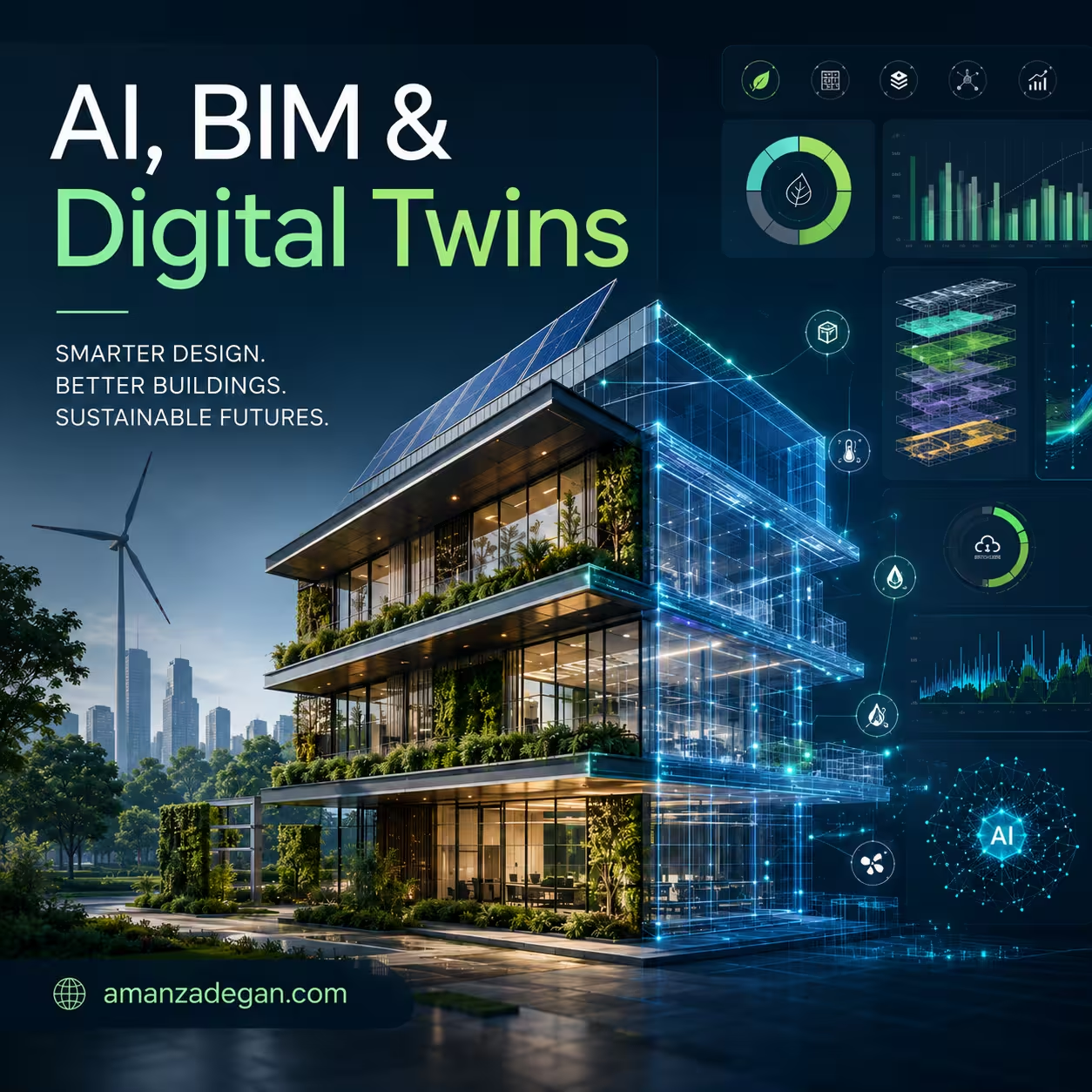
This is where AI, BIM, and digital twins begin to converge. BIM organizes building information. AI analyzes patterns, predicts outcomes, and assists decision-making. Digital twins connect the model to real-world performance over time. Together, they can move sustainable architecture from static design claims toward lifecycle intelligence.
Why Sustainability Needs Better Data
Sustainable design depends on early decisions, but many environmental impacts are discovered too late. A façade choice affects daylight, heat gain, cooling loads, operational energy, and occupant comfort. A structural system affects embodied carbon, construction logistics, cost, and future adaptability.
These decisions cannot be managed well if information is scattered across drawings, spreadsheets, reports, and isolated software. BIM offers a shared information structure. AI can help interpret and optimize that structure. Digital twins can test whether the building performs as expected after handover.
From Design Model to Lifecycle Intelligence
A conventional BIM model may help coordinate drawings and quantities. A sustainability-oriented BIM model should also support lifecycle questions: what is the embodied carbon impact of the structural system, how orientation affects solar exposure, which façade option balances daylight and cooling demand, and how the building will perform after occupancy.
These questions require structured data across the building lifecycle.
The Role of AI in Sustainable Architecture
Early option analysis
AI can compare design alternatives based on daylight, area efficiency, massing, solar exposure, and preliminary energy impact.
Energy performance prediction
Machine learning can help predict building energy use based on design parameters, climate data, occupancy assumptions, and system performance.
Material and carbon intelligence
AI can help identify anomalies, compare material options, and connect BIM quantities to carbon databases.
Operational optimization
AI can analyze sensor data from occupied buildings to improve HVAC, lighting, comfort, and maintenance.
Predictive maintenance
AI can identify patterns that suggest equipment failure or performance degradation before costly problems occur.
BIM as the Sustainability Data Backbone
BIM is essential because sustainability analysis needs context. A carbon number is not meaningful without knowing which element it belongs to, what material it uses, where it is located, how much quantity is involved, and what lifecycle stage is being evaluated.
A BIM model can connect geometry, quantities, material specifications, space data, system data, classification, cost data, carbon factors, maintenance information, and asset identity.
Embodied Carbon and Material Intelligence
Operational energy has long been a central topic in sustainable design. Today, embodied carbon is becoming equally important. Embodied carbon refers to emissions associated with materials, manufacturing, transportation, construction, maintenance, replacement, and end-of-life processes.
BIM can support embodied carbon workflows by linking model quantities and material specifications to carbon data. This shows an important trend: sustainability data is becoming computational.
Digital Twins and Operational Performance
Design-stage sustainability is only half the story. The building must perform after occupancy. A digital twin can connect the design model to operational data such as HVAC performance, energy consumption, occupancy patterns, indoor air quality, lighting use, maintenance events, equipment behavior, and environmental sensors.
This creates a feedback loop. Instead of guessing how buildings perform, architects and owners can learn from actual use.
Sustainability Data Layers in AI-BIM-Digital Twin Workflows
| Layer | Data type | AI contribution | Sustainability value |
|---|---|---|---|
| Site | Climate, orientation, context | Solar and environmental pattern analysis | Better massing and passive design |
| Geometry | Areas, volumes, envelope | Option comparison | Efficient form and space planning |
| Materials | Specifications, quantities | Carbon comparison and anomaly detection | Lower embodied carbon |
| Systems | HVAC, lighting, MEP | Performance prediction | Lower operational energy |
| Occupancy | Use patterns, comfort data | Behavioral and demand analysis | Better comfort and efficiency |
| Operations | Sensors, maintenance logs | Predictive maintenance | Longer asset life |
| Feedback | Post-occupancy data | Learning loop for future projects | Evidence-based design improvement |
AI and the Performance Gap
One major sustainability challenge is the performance gap: the difference between predicted building performance and actual building performance. This gap can result from unrealistic assumptions, poor commissioning, occupant behavior, construction changes, system mismanagement, or missing data.
AI and digital twins can help reduce the performance gap by continuously comparing expected and actual performance. When a building uses more energy than expected, the system can help identify possible causes.
The Importance of Standards and Information Management
Sustainability workflows fail when data is inconsistent. If material names are unclear, quantities are wrong, systems are not classified, or asset data is missing, AI cannot create reliable analysis.
A credible AI-BIM sustainability workflow should include defined information requirements, clear material naming, quantity validation, carbon factor source documentation, assumption tracking, version control, human review, and post-occupancy feedback.
Smart Buildings Are Not Automatically Sustainable
A smart building is not necessarily a sustainable building. A building can have sensors, automation, dashboards, and AI systems while still consuming too much energy or using high-impact materials. Technology must serve environmental performance, not simply add complexity.
AI for Low-Carbon Design Thinking
AI should not be understood as a replacement for sustainable design thinking. It should be used to make design thinking more evidence-based. The architect still defines values, acceptable trade-offs, lifecycle priorities, and environmental responsibility.
Practical Workflow for AI-BIM Sustainability
- Define sustainability goals at the start.
- Create an information requirement matrix.
- Build or audit the BIM model for data quality.
- Link model quantities to carbon and material data.
- Run early massing and daylight studies.
- Compare design options through measurable criteria.
- Document assumptions and limitations.
- Prepare the model for operations and handover.
- Connect operational data where possible.
- Use post-occupancy feedback for future design improvement.
Conclusion
AI, BIM, and digital twins can make sustainable architecture more measurable, transparent, and adaptive. BIM structures the data. AI helps analyze and predict. Digital twins connect design intent to real building performance.
But technology alone is not enough. Sustainable outcomes require clear information management, reliable carbon data, professional judgment, and a willingness to measure what happens after the building is occupied.
FAQ
How do AI and BIM support sustainable architecture?
BIM organizes building data, while AI helps analyze options, predict performance, compare materials, and support better lifecycle decisions.
What is the role of digital twins in sustainability?
Digital twins connect building models to real operational data, helping owners monitor performance, optimize systems, and reduce waste.
Can AI calculate embodied carbon automatically?
AI can assist with data processing and anomaly detection, but reliable carbon calculation still requires accurate BIM quantities and trusted carbon databases.
Are smart buildings always sustainable?
No. Smart technologies only support sustainability when they improve measurable environmental performance and are properly managed.
References
- Autodesk. How AI in architecture is shaping the future of design and construction. https://www.autodesk.com/design-make/articles/ai-in-architecture
- Autodesk. What is a digital twin? https://www.autodesk.com/design-make/articles/what-is-a-digital-twin
- BSI. ISO 19650 – Managing Information with Building Information Modelling. https://www.bsigroup.com/en-GB/products-and-services/standards/iso-19650-building-information-modelling-bim/
- Building Transparency. EC3 and embodied carbon data tools. https://www.buildingtransparency.org/
- Building Transparency. EC3 2.0: AI-enabled data quality and embodied carbon infrastructure. https://www.buildingtransparency.org/ec3-2-0-modernizing-open-infrastructure-for-embodied-carbon/
- RIBA. Artificial Intelligence Report 2025. https://www.riba.org/work/insights-and-resources/ai-report/riba-ai-report-2025/