


AI-Ready BIM: Why Clean Building Data Matters More Than Bigger AI Models
Artificial intelligence is quickly becoming part of architectural practice, from concept visualization and generative layouts to automated documentation, compliance checking, and facility management. Yet one issue is often underestimated: AI does not magically understand a building. It reads data, patterns, geometry, labels, relationships, and structured information.
For architecture and construction, this means that the real foundation of AI is not the prompt. It is the building information model.
A BIM model can be visually impressive but computationally weak. If walls, spaces, materials, fire ratings, room names, levels, systems, and classification data are inconsistent, an AI system may produce fluent but unreliable results. The future of AI in architecture therefore depends on a shift from “modeling for drawings” to “modeling for intelligence.” This is the idea behind AI-ready BIM.
What Does AI-Ready BIM Mean?
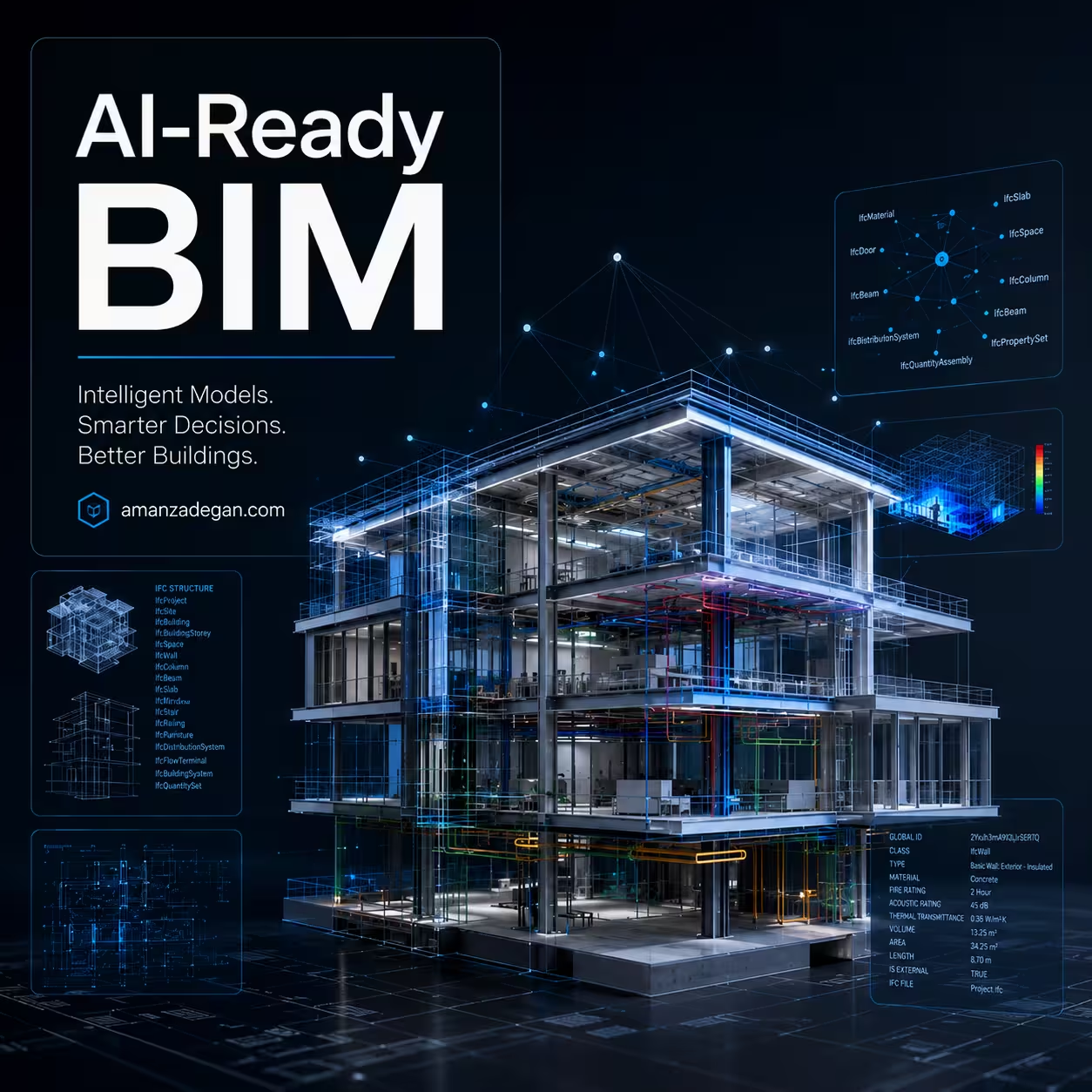
AI-ready BIM is a building information model prepared in a way that machine systems can reliably interpret, validate, query, analyze, and reuse. It is not simply a Revit, Archicad, or IFC file. It is a structured information environment where geometry, metadata, naming conventions, classifications, exchange requirements, and project rules are consistent enough to support automated reasoning.
In practical terms, AI-ready BIM means building elements are correctly categorized, spaces and zones are consistently named, materials and systems include usable performance data, parameters are not duplicated or randomly named, and information requirements are defined before data is produced.
The difference is important. A conventional BIM model supports coordination. An AI-ready BIM model supports computation.
Why BIM Data Quality Is Now a Strategic Issue
Architectural teams often treat BIM data quality as a documentation problem. In an AI workflow, it becomes a strategic problem. If an AI assistant is asked to compare fire-rated walls, identify missing accessibility data, estimate embodied carbon, or summarize room schedules, the result depends on whether the source model contains valid information.
A large language model may understand the question linguistically, but it still needs reliable structured data to produce a useful answer. This is why BIM and AI should not be discussed only as software trends. They should be discussed as information management systems.
From BIM Model to AI Knowledge Layer
In a traditional workflow, BIM is often used to produce drawings, schedules, clash reports, and coordination packages. In an AI-enhanced workflow, BIM becomes a knowledge layer that can feed LLM-based model queries, automated compliance checking, design option comparison, energy and carbon analysis, digital twin operations, predictive maintenance, facility management dashboards, and construction sequencing intelligence.
This transition changes the role of the architect. The architect is no longer only a designer of spatial form. The architect becomes a designer of structured information.
The Role of IFC in AI-Ready BIM
Industry Foundation Classes, or IFC, are central to openBIM because they allow building data to be exchanged in a vendor-neutral format. For AI workflows, IFC is valuable because it can provide a structured representation of building elements, properties, spatial hierarchy, systems, and relationships.
However, exporting to IFC is not enough. An IFC model with poor naming, missing properties, or inconsistent classification remains weak. AI workflows need both open data and reliable data.
Why IDS Matters for Automated Model Checking
Information Delivery Specification, or IDS, is a buildingSMART standard that defines exchange requirements in a computer-interpretable form. IDS allows automatic compliance checking of IFC models and helps define what objects, classifications, materials, properties, and values should be delivered.
For AI-ready BIM, IDS is powerful because it turns vague expectations into checkable rules. Instead of saying “the model should include fire safety information,” a project team can define exactly which wall objects must contain which fire-rating property and which values are accepted.
ISO 19650 and Information Governance
ISO 19650 provides an international framework for managing information over the lifecycle of a built asset using BIM. For AI adoption, this is essential. Without clear roles, information requirements, naming conventions, and approval workflows, AI can accelerate confusion.
An AI-ready BIM strategy should include model purpose definition, exchange information requirements, responsibility matrices, naming and classification standards, model checking protocols, version control, data security rules, and human review procedures.
Conventional BIM vs AI-Ready BIM
| Layer | Conventional BIM | AI-Ready BIM |
|---|---|---|
| Main purpose | Documentation and coordination | Computation, reasoning, analysis, automation |
| Data quality | Often project-dependent | Defined by standards and validation rules |
| Model checking | Manual or semi-manual | Automated through IDS, IFC validation, and rule sets |
| AI usability | Limited and inconsistent | Queryable, analyzable, and reusable |
| Interoperability | Export-based | OpenBIM-oriented and structured |
| Lifecycle value | Often reduced after handover | Supports digital twins and operations |
AI-Ready BIM and Digital Twins
Digital twins are often presented as the next stage after BIM. A digital twin is not just a 3D model; it is a dynamic digital representation connected to real-world data and asset performance. This makes BIM data quality even more important.
A digital twin built from poor BIM data becomes an expensive visualization layer. A digital twin built from AI-ready BIM can support performance prediction, maintenance planning, energy monitoring, and lifecycle decision-making.
The Risk of AI Without Structured BIM
Hallucinated certainty
AI may generate confident explanations based on incomplete or incorrect model information.
False compliance
A model may appear compliant because the AI summary sounds correct, while required properties are missing.
Broken handover
Facility managers may receive beautiful visual models without usable operational data.
Poor decision traceability
Design teams may not know why an AI recommendation was made or which data it used.
A Practical AI-Ready BIM Checklist
- Are model elements correctly classified?
- Are spaces, zones, and systems consistently named?
- Are required parameters complete?
- Are information requirements defined in a checkable format?
- Can the model be exported to IFC without critical information loss?
- Are materials linked to performance or carbon data where relevant?
- Are AI outputs reviewed by a qualified professional?
Why This Matters for Architects
AI will not make BIM less important. It will make BIM more important. The architect who understands geometry, information structure, performance criteria, and AI-assisted analysis will have a stronger role in future workflows than the architect who only uses AI for images.
In this sense, AI-ready BIM is not a technical detail. It is a professional positioning strategy.
Conclusion
The next generation of architectural intelligence will not be built only on bigger AI models. It will be built on better building data. AI-ready BIM requires structured information, open standards, model governance, and professional judgment.
The future belongs not to the fastest prompt writer, but to the architect who can connect design intent, BIM structure, computational analysis, and human accountability.
FAQ
What is AI-ready BIM?
AI-ready BIM is a structured building information model prepared for machine interpretation, automated checking, analysis, and reuse across design, construction, and operation.
Is AI-ready BIM the same as using AI in Revit?
No. Using AI in Revit is a tool-level action. AI-ready BIM is a broader information strategy involving data quality, standards, validation, governance, and interoperability.
Why is IDS important for AI and BIM?
IDS defines information requirements in a computer-interpretable format, making it easier to check whether IFC models contain the required properties, values, and classifications.
Does AI reduce the need for BIM standards?
No. AI increases the need for BIM standards because automated systems require reliable, structured, and consistent information.
References
- Heidari, A., Peyvastehgar, Y., & Amanzadegan, M. A systematic review of the BIM in construction: from smart building management to interoperability of BIM & AI. Architectural Science Review. https://www.amanzadegan.com/from-smart-building-management-to-interoperability-of-bim-ai-a-systematic-review-of-the-bim-in-construction/
- buildingSMART International. Information Delivery Specification. https://www.buildingsmart.org/standards/bsi-standards/information-delivery-specification-ids/
- BSI. ISO 19650 – Managing Information with Building Information Modelling. https://www.bsigroup.com/en-GB/products-and-services/standards/iso-19650-building-information-modelling-bim/
- Autodesk. What is a digital twin? https://www.autodesk.com/design-make/articles/what-is-a-digital-twin
- Autodesk. How AI in architecture is shaping the future of design and construction. https://www.autodesk.com/design-make/articles/ai-in-architecture