


LLMs for BIM: How Natural-Language AI Is Changing Revit, IFC and Design Automation

LLMs for BIM: How Natural-Language AI Is Changing Revit, IFC and Design Automation
Large language models are changing the way architects interact with digital tools. Until recently, most BIM automation required scripting knowledge, visual programming, API experience, or a dedicated computational design specialist. Today, natural-language AI is making it possible to ask a design system to explain, query, generate, or modify building information through conversational instructions.
This does not mean BIM is becoming automatic. It means the interface between the architect and the model is changing. The most important shift is from command-based modeling to intent-based modeling.
What Are LLMs in a BIM Context?
A large language model, or LLM, is an AI system trained to understand and generate language. In BIM, LLMs can be used as a layer between human instructions and building data.
They can support model querying, Dynamo or Python script generation, Revit task automation, IFC data interpretation, design rule explanation, compliance checking, room schedule summaries, model quality reports, parametric design assistance, and natural-language documentation.
Why BIM Needs Better Interfaces
BIM tools are data-rich, but many architectural teams use only a fraction of their computational potential. A model may contain thousands of elements and parameters, but extracting meaningful information can require schedules, filters, custom scripts, or API-level workflows.
Natural-language interfaces can reduce that barrier. Instead of manually building a schedule, a designer could ask the system to list all rooms larger than 20 square meters that do not have a daylight-related parameter, or to find external walls without thermal performance data.
From Prompt to Model Operation
An LLM-based BIM workflow usually involves several layers: the user describes a goal, the LLM interprets the instruction, the system maps the request to BIM data or a software API, a script or query is generated, and the output is checked against model rules and professional judgment.
This means the prompt is only the beginning. The quality of the final result depends on the reliability of the model data, the tool integration, and the validation process.
Revit, Dynamo and AI-Assisted Automation
Revit and Dynamo are natural candidates for LLM-based workflows because they already support model automation through scripting and visual programming. A practical AI-assisted workflow might begin with a repetitive modeling or documentation task, continue with an AI-generated Dynamo Python script, and end with review, testing, and validation on a copy of the model.
This can be useful for renaming views and sheets, checking missing parameters, creating schedules, extracting quantities, placing annotation elements, generating early design layouts, validating room data, and preparing model reports.
IFC and LLMs: A More Open Direction
The long-term potential of LLMs in BIM may be stronger when connected to open standards such as IFC. IFC-based workflows allow AI systems to query and manipulate building data without being locked into one authoring tool.
This is important because the future of AI in architecture should not depend only on proprietary file formats. OpenBIM can make AI workflows more transparent, transferable, and research-friendly.
Domain-Specific BIM Language Models
General-purpose LLMs are impressive, but BIM is a specialized domain. A model needs to understand not only language, but also architectural elements, spatial hierarchy, object properties, building codes, units, classifications, and design constraints.
This points toward an important future: architecture may need domain-specific AI systems rather than generic chatbots.
What LLMs Can Do in BIM Workflows
| BIM task | LLM contribution | Required human check |
|---|---|---|
| Model query | Translate natural language into data queries | Confirm extracted data is complete |
| Dynamo scripting | Generate Python or node logic | Review code before execution |
| IFC analysis | Read and summarize structured model data | Validate IFC export quality |
| Compliance checking | Interpret rules and identify possible violations | Confirm with code specialist |
| Documentation | Draft summaries and reports | Verify technical accuracy |
| Design generation | Create layout or massing logic | Evaluate spatial quality and feasibility |
LLMs and Code Compliance Checking
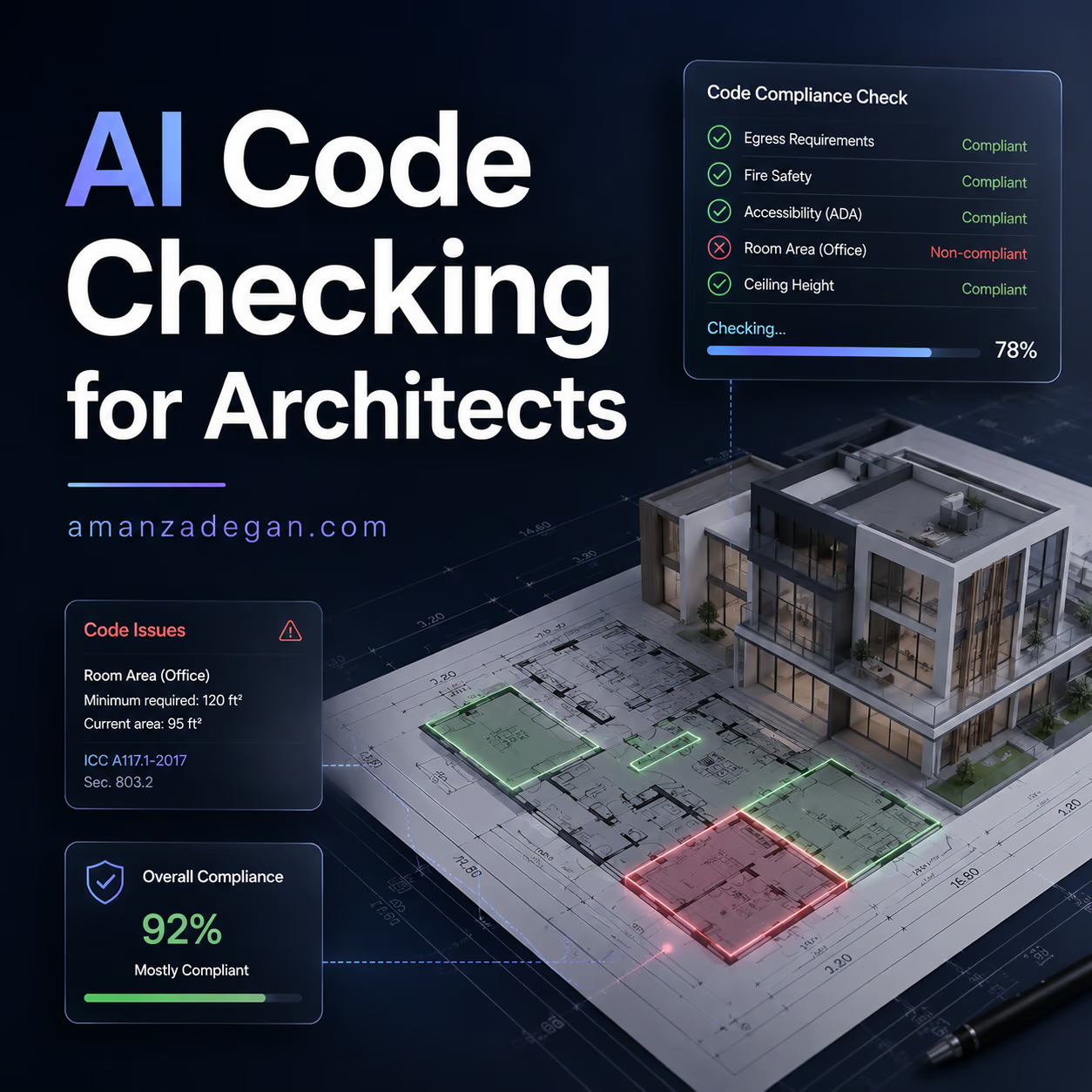
One of the most promising applications of LLMs in BIM is semi-automated compliance checking. Building codes are language-heavy, complex, and often difficult to translate into model rules. LLMs can help interpret regulatory text, generate checking logic, and produce reports.
This does not eliminate the need for architects, engineers, or code consultants. Instead, it can reduce repetitive checking and help teams identify issues earlier.
Text-to-Layout and Schematic Design
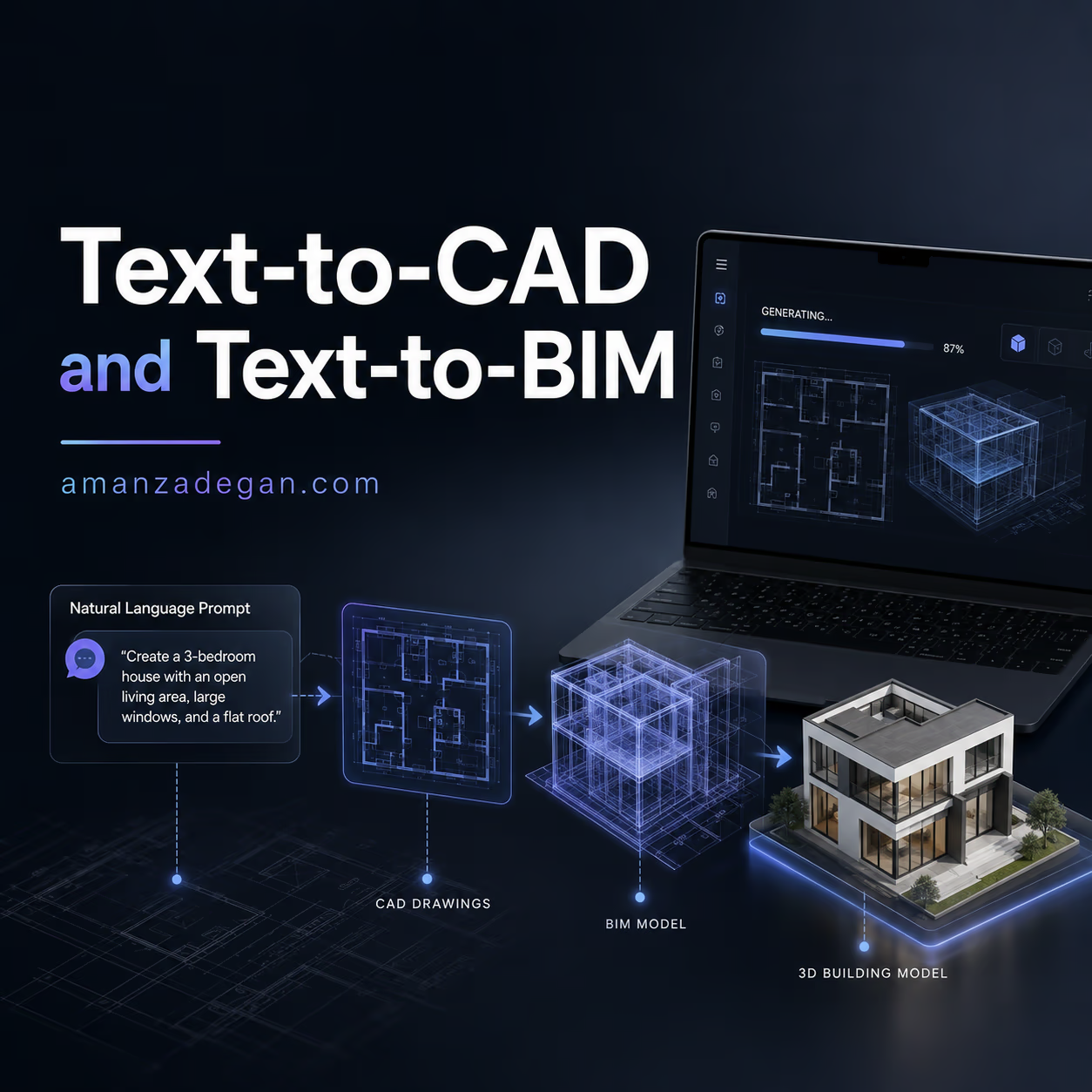
LLMs are also being explored for early plan generation. Text-to-layout workflows can interpret natural-language prompts and generate draft plans with walls, doors, windows, and furniture arrangements compatible with BIM environments.
For architecture, this is not simply about speed. It changes how early-stage design options can be produced, compared, and discussed.
The Risks of LLM-Based BIM
Hallucinated model operations
An LLM may generate a script that looks correct but calls nonexistent parameters or creates unintended model changes.
Data privacy
BIM models often contain confidential project information. Sending model data to cloud-based AI tools can create legal and contractual risks.
Poor technical validation
A script may run successfully but produce incorrect architectural results.
Lack of accountability
If an AI-assisted compliance report is wrong, responsibility still belongs to the professional team.
A Professional Workflow for LLMs in BIM
- Use a copy of the model for AI-generated scripts.
- Never run AI-generated code without review.
- Define naming standards and parameter rules first.
- Use IFC or structured exports when possible.
- Keep sensitive client data out of public AI tools.
- Document what was AI-assisted.
- Validate outputs through model checks and expert review.
Why This Is a Design Technology Opportunity
LLMs are not important because they can write text. They are important because they can become a bridge between design intent and computational execution.
The most valuable architect will not be the one who lets AI generate everything. It will be the one who can structure the problem, evaluate the output, and integrate automation into a thoughtful design process.
Conclusion
LLMs are changing BIM by making model interaction more conversational, accessible, and automated. They can assist with Revit scripting, Dynamo workflows, IFC querying, compliance checking, and early-stage layout generation.
But their value depends on structured data, open standards, careful validation, and professional responsibility.
FAQ
Can LLMs create BIM models?
They can assist with model generation, scripting, querying, and layout creation, but professional review is still required.
Are LLMs reliable for Revit automation?
They can be useful for generating scripts, but outputs must be reviewed and tested before being used in production models.
Why is IFC important for LLM-based BIM?
IFC allows AI systems to work with open building data instead of depending only on proprietary software formats.
Can AI check building codes automatically?
AI can assist with semi-automated code checking, but legal and professional responsibility remains with qualified experts.
References
- Ko, J. Generative AI-powered parametric modeling and BIM for architectural design and visualization. https://www.cambridge.org/core/services/aop-cambridge-core/content/view/A76987B083B87FA9E8579B1DCA532A0B/S2732527X25102083a.pdf/generative-ai-powered-parametric-modeling-and-bim-for-architectural-design-and-visualization.pdf
- Nithyanantham, B. K., et al. MCP4IFC: IFC-Based Building Design Using Large Language Models. https://arxiv.org/abs/2511.05533
- Lin, J.-R., et al. Qwen-BIM: Developing large language model for BIM-based design with domain-specific benchmark and dataset. https://arxiv.org/abs/2602.20812
- Madireddy, S., et al. Large Language Model-Driven Code Compliance Checking in Building Information Modeling. https://arxiv.org/abs/2506.20551
- Duggempudi, J., et al. Text-to-Layout: A Generative Workflow for Drafting Architectural Floor Plans Using LLMs. https://arxiv.org/abs/2509.00543